
Serving Colchester, East Haddam, East Hampton, Hebron, Marlborough, Portland
Power Outage Safety Tips
POWER Outage
basics
Power Outage Basics
-
Keep freezers and refrigerators closed.
-
Use a generator, but ONLY outdoors and away from windows.
-
Do not use a gas stove or oven to heat your home.
-
Disconnect appliances and electronics to avoid damage from electrical surges.
-
Have alternate plans for refrigerating medicines or using power-dependent medical devices.
-
Check with local officials about heating and cooling locations open near you.
Learn more from Ready.gov
HERE
Generator
Safety
Portable back-up generators produce carbon monoxide (CO). This poisonous, odorless, colorless gas can kill without warning.
-
Never use a generator inside your home or garage, even if doors and windows are open.
-
Only use generators outside, more than 20 feet away from any windows, doors, and vents.
-
When using a generator, use a battery-powered or battery backup CO detector in your home.

Source: CDC
food safety
during and after power outage
Before a power outage
-
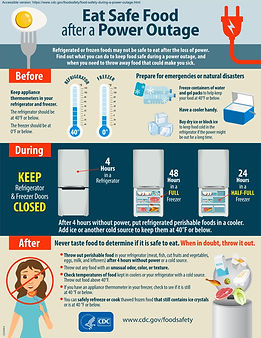
Keep refrigerator and freezer doors closed.
-
If the doors stay closed, food will stay safe up to: 4 hours in a refrigerator, 48 hours in a full freezer, 24 hours in a half-full freezer.
-
After a power outage
-
Food may look fine after a power outage, but once it warms above 41°F bacteria multiply rapidly and can produce toxins that you can’t see, smell, or cook away. The safest option is to discard it to prevent illness.
-
Throw out perishable food in your refrigerator (meat, fish, cut fruits and vegetables, eggs, milk, and leftovers) after 4 hours without power or without a cold source like ice.
-
Throw out any food with an unusual smell, color, or texture.
-
You can safely refreeze or cook thawed frozen food that still contains ice crystals or is at 40 °F or below.
Learn more from CDC
HERE